Meme coin trading can turn a small bankroll into seven figures if you treat it as a full-time job with strict risk control
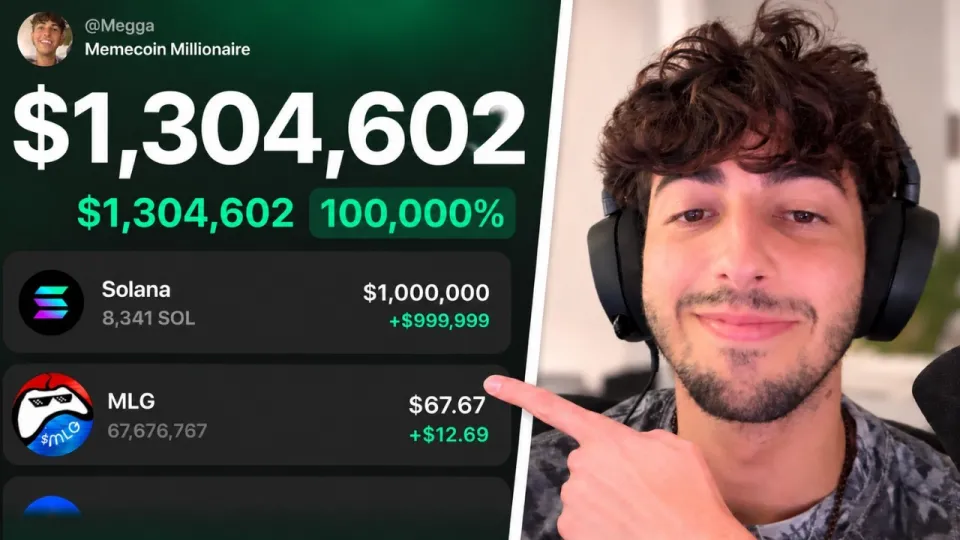
Video: How I Made $1,000,000 Trading Memecoins (FULL BREAKDOWN)
Need articles like this for your video? They help promote it on YouTube and Google — order them in the Telegram bot @sat_sit_bot. It writes articles around your video, embeds the video and publishes them on popular niche websites (no ads). Your first 50 articles are free.
· based on the channel Megga
Key takeaways
- Megga's breakdown covers a seven-figure result built entirely in the memecoin 'trenches', not in blue-chip crypto.
- The core routine described is 9–12 hours a day of screening new launches, tracking narratives and managing positions.
- A free course on the strategy is distributed through the Whop checkout link in the video description.
- Trading is routed through Padre, which the creator promotes as the lowest-fee platform for memecoin execution.
- Most viewer pushback centres on liquidity: every dollar won in memecoins comes from another trader's loss.
Meme coin trading is the practice of buying and selling tokens with no cash flow, no product and no fundamentals, where price is driven purely by attention, liquidity and narrative speed. Done with discipline and volume, it can compound a small bankroll into seven figures — which is exactly the result Megga breaks down in his full PnL walkthrough, and the free course behind that method is available through the Whop checkout page.
What a $1,000,000 meme coin result actually consists of
A seven-figure memecoin PnL is not one lucky 1000x; it is the sum of hundreds of asymmetric bets where the winners are sized larger than the losers. The math is unglamorous: if you risk 1–3% of your bankroll per position and one in twenty tokens returns 10x–50x, the portfolio compounds as long as you never let a single position wipe out the account. Megga's breakdown frames the journey as a grind rather than a jackpot — long stretches of small losses, occasional outsized wins, and a bankroll that only steps up after the strategy has been proven over months.
Three things separate this from gambling:
- Position sizing. Every entry has a defined amount of capital behind it, decided before the trade, not after the chart moves.
- Exit rules. Profits are taken in tranches instead of waiting for a token to "go parabolic" forever.
- Record keeping. Tracking all-time PnL, not just the wins, is what makes the result verifiable and repeatable.
The daily routine behind trench trading
Trench trading means working the earliest, least liquid stage of a token's life — the moment it launches on a bonding-curve platform, before any exchange listing. Megga describes locking in 9 to 12 hours a day, and that time is not spent staring at one chart. A realistic session looks like this:
- Scanning. Reviewing dozens of new launches per hour, filtering by holder distribution, dev wallet behaviour and social traction.
- Narrative mapping. Grouping tokens by the meta of the week — animal coins, political coins, AI coins, community forks — and positioning in the strongest one early.
- Execution. Entering small, adding only when the token proves it can hold a bid, and cutting fast when volume dries up.
- Review. Logging every trade with the thesis, the outcome and the mistake, so patterns repeat deliberately rather than accidentally.
The honest version of this lifestyle is boredom punctuated by 90-second decisions. Most days end flat or slightly red; the account grows on the handful of days when a position runs.
Why most beginners become exit liquidity
In a memecoin, there is no revenue and no buyer of last resort — every dollar of profit is another participant's loss, plus fees. That is the uncomfortable truth behind the skeptical comments under the video, and it is the single most important thing a newcomer can internalise. The trader on the other side of your buy is often faster, better informed, or holding tokens from a wallet you cannot see.
Common ways beginners donate their bankroll:
- Chasing green candles after a token has already run 300%, buying the top of a pump they discovered on social media.
- Ignoring holder concentration, where one wallet controls enough supply to dump the entire chart in a single transaction.
- Oversizing on conviction, putting a third of the account into a token because the community feels energetic.
- No exit plan, holding a 5x back to zero because selling felt like admitting the thesis was only a trade.
- Wallet hygiene failures. Phishing links and malicious token approvals drain wallets; one bad signature can erase months of gains, and recovering mentally from that is often harder than recovering financially.
Skills that separate profitable meme coin traders from tourists
The edge in memecoins is speed plus judgement, and both are trainable. Judgement means reading a token's on-chain profile — how supply is distributed, whether early wallets are clustered, whether liquidity is locked — before price confirms anything. Speed means having a workflow ready so that when a setup appears you are executing in seconds, not minutes.
A practical progression for someone starting with a small account:
- Paper-track for two weeks. Log 50 hypothetical entries with entry, exit and reasoning. Compare results against what actually happened.
- Start with a tiny live bankroll you can lose entirely without changing your life, and treat the first month as tuition.
- Specialise in one meta at a time. Becoming the person who understands one category of launch deeply beats shallow coverage of everything.
- Build a network. Group chats, X communities and live streams compress the learning curve dramatically, because you see other traders' reasoning in real time.
- Scale only after consistency. Increase size when three consecutive months show positive all-time PnL, not after one good week.
Questions traders keep asking after the breakdown
Viewers consistently raise the same practical concerns, and they deserve direct answers. The first is time: many people watching have jobs and cannot commit 9–12 hours a day. The realistic adaptation is to pick one or two high-conviction sessions per week, use pre-set alerts, and accept a slower compounding curve — the strategy still works, it just scales down. The second is verification: how do you confirm a result is real? Ask for wallet addresses, on-chain history and a public PnL tracker; screenshots alone prove nothing.
The third recurring question is about networking — how much capital you need before approaching other traders or joining private groups. There is no universal threshold, but the useful signal is a documented track record rather than a bankroll number; someone with a verified, modest PnL and clear reasoning is a better collaborator than a large account with no history. The fourth is intuition: how do you know a narrative will work before it is obvious? You do not — you build a base rate by studying previous metas, entering early with small size, and letting the market tell you whether the thesis is right. Intuition in this market is just pattern recognition earned through repetition.
Useful links
- Free course on the strategy: https://whop.com/checkout/plan_Jfp7BxTu8pWGu/?session=chs_HL1L0oQ9QcTEa3
- Trading platform promoted as lowest-fee: https://trade.padre.gg/rk/megga
- Twitch streams: http://www.twitch.tv/megga
- TikTok: https://www.tiktok.com/@meggafaze
- Twitter/X: https://twitter.com/megga
Final thoughts on building a seven-figure meme coin account
The $1,000,000 figure is the headline, but the transferable lesson is process: defined risk per trade, obsessive screening, honest record keeping and the mental stamina to keep showing up through drawdowns. Memecoins reward speed and punish ego, and the traders who survive are the ones who treat losses as data rather than verdicts. Megga's breakdown is worth watching precisely because it shows the grind behind the number rather than the number alone. If you want the structured version of the method, start with the free course via Whop and treat everything else as practice.
Questions & answers
How much capital do you need to start trading meme coins seriously?
There is no fixed minimum, but the practical rule is to start with an amount you can lose entirely without affecting your finances, often a few hundred dollars. Size should grow only after several months of documented, positive all-time PnL rather than after a single lucky win.
Is meme coin trading the same as gambling?
The mechanics overlap, but the difference is process: fixed position sizing, pre-defined exits and tracked results turn repeated asymmetric bets into a strategy. Without those three elements, trading memecoins is effectively gambling with extra steps.
How can you tell whether someone's claimed meme coin profits are real?
Ask for wallet addresses and on-chain history that can be checked independently, plus a public PnL tracker covering losses as well as wins. Screenshots and highlight reels prove nothing, because a single wallet can be one of many.
Can you trade memecoins with a full-time job?
Yes, but the model changes: fewer sessions, pre-set alerts and a focus on the strongest narratives instead of constant scanning. Compounding will be slower than a 9-to-12-hour daily routine, and the risk of chasing late entries increases, so position sizing matters even more.
Source: How I Made $1,000,000 Trading Memecoins (FULL BREAKDOWN) · Markdown version